Showing posts with label art. Show all posts

Wednesday, September 28, 2011

The da Vinci Coda - A Michigan Horse Tale


In 1499, the victorious army of Louis XII of France entered Milan, Italy by the Vercellina Gate and camped in the neighborhood of San Vittore al Corpo. On entering the city, the soldiers came upon an enormous clay sculpture of a horse. Commissioned by the Duke of Milan, Ludovico Sforza, in honor of his father and as a symbol of the power of the Milan, the finished statue in bronze was to be placed before the Sforza Castle.

Flush with victory and perhaps anticipating more battles to come, the French soldiers used the statue for archery practice. In the ensuing years, the elements reduced the already partially-destroyed clay sculpture to rubble. Thus, one of the great works of the Italian Renaissance genius Leonardo da Vinci disappeared forever. 

Thousands of miles and hundreds of years removed from Milan, Italy, is Grand Rapids, Michigan, home to the Frederik Meijer Gardens & Sculpture Park. Recently, after taking a visiting relative to the Grand Rapids airport, we passed the gardens on our way back to our cabin in northern Michigan and decided to pay them a visit. As expected, we found well-tended flower gardens, fountains, winding paths and beautiful sculptures, by artists such as Rodin, Picasso, Miro and Moore. What we did not expect to find was the reincarnation of Leonardo da Vinci's monumental horse.

Leonardo worked on il cavallo from 1482 to 1493, first on the artistic and anatomical elements of the horse and then on the more difficult technical problems associated with the bronzing of what would have been the world's largest equestrian statue. Work was stopped, however, when Ludovico decided to use the 100 tons of bronze needed to cover the seven-meter (23 feet) statute to make canons to defend Milan from the invading French. The effort was futile. Milan fell, Ludovico was imprisoned and the sculpture was lost.

In 1977, Charles Dent, an American airline pilot and amateur art lover read an article in National Geographic magazine. Entitled "The Horse That Never Was," the article told the story of Leonardo's legendary destroyed masterpiece. Dent decided, then and there, to recreate the lost sculpture and gift it to the City of Milan. He started a foundation and raised $2.5 million.

Dent produced a model for the replica of Leonardo's horse, but although a great lover of art, Dent was not an artist, It became obvious that a professional sculptor was needed to make improvements to the existing model. Nina Akamu, an talented American artist, particularly known for her animal sculpture, was given the commission. Then in 1994, Charles Dent died.

Dent's horse also seemed moribund when in stepped Frederik Meijer. The owner of a supermarket chain in Michigan and a well-known philanthropist, Meijer had read about the project in an article in the New York Times. He agreed to finance the effort and Akamu set about creating her own model.

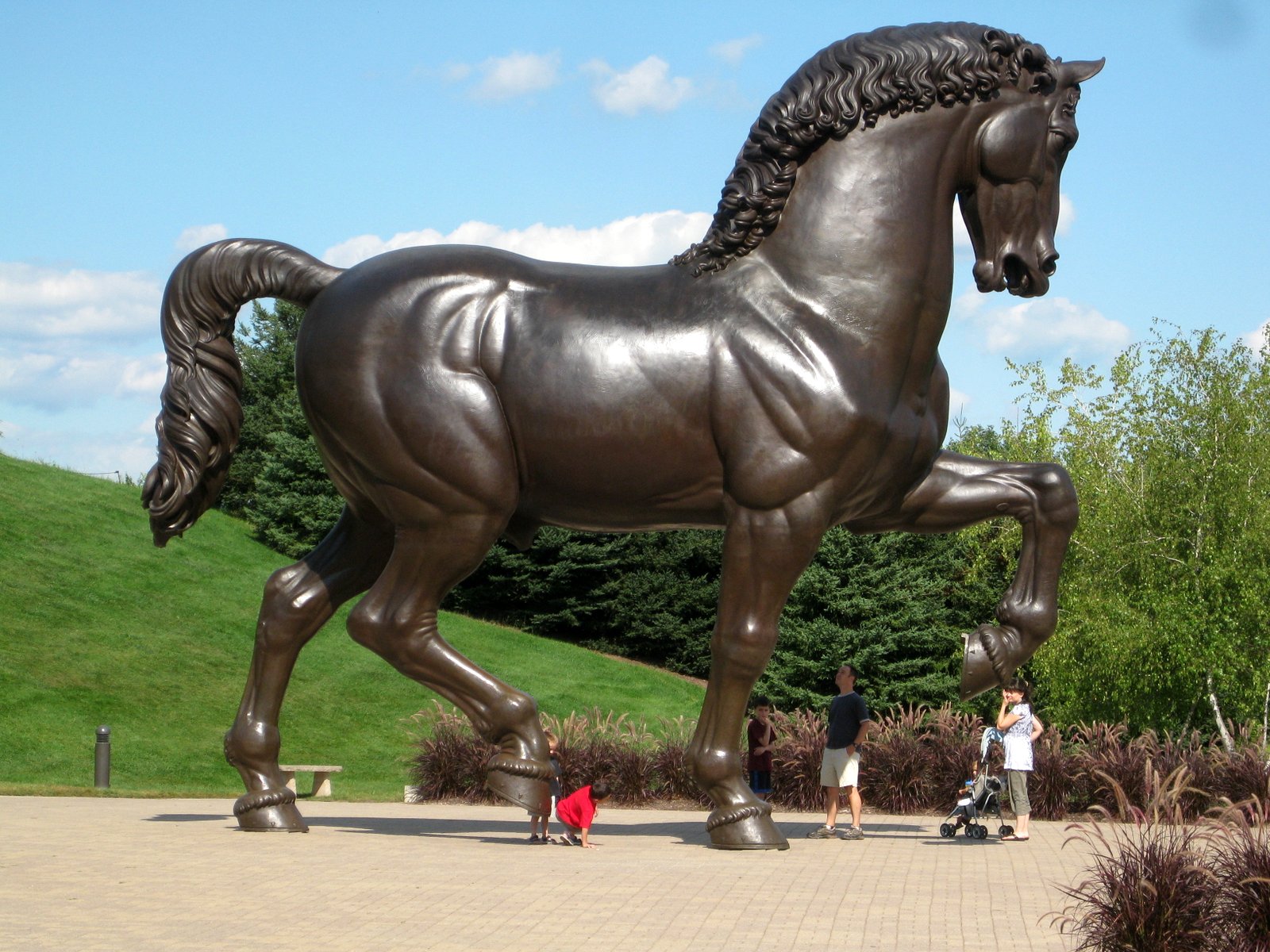
Although many of Leonardo's notebooks still exist and are filled with drawings of horses, there is no definitive sketch of the 15th-century Milan horse. Akamu, however, studied the notebooks and other works by Leonardo to come up with her 24-foot-high sculpture, entitled The American Horse, which she feels  is true to Leonardo's designs.  

In 1999, five hundred years after Leonardo's model was destroyed, The American Horse was installed at Meijer Gardens. The same year an identical casting was given to the City of Milan. Il Cavallo, as it is known in Italy, stands at the gates of the San Siro Race Course, far from the City Center.

In 2007, the City of Milan announced that Il Cavallo would be moved from the race track to the park grounds of the Sforza Castle, its original intended site. So far, however, no plans have been made for the move.

The Sforza Castle has been waiting for its monumental sculpture for more than 500 years, but - since things often move slowly in Italy - it looks as if it will have to wait a bit longer.

(There's lots more to see and do at the lovely Meijer Gardens.  To visit their web page, click here.)

Click here to see more photos.


Ciao,
Geraldine


Photos by Geraldine Calisti Kaylor

Wednesday, January 19, 2011

THE PATH OF THE IMPRESSIONISTS


In the summer of 1880, the Impressionist painter Pierre-Auguste Renoir was in Chatou, hard at work on a future masterpiece. He invited a friend in Paris to come for a visit. "You won't regret the trip, I assure you" Renoir wrote. "There is not a lovelier place in all the surroundings of Paris."  

Courtesy Phillips Collection
The painting that Renoir was working on was "The Luncheon of the Boating Party" (Le Dejeuner des Canotiers). In it, many of Renoir's friends, including his future wife, Aline Charigot, sit in the sparkling sunlight on the balcony of la Maison Fournaise, a guingette in Chatou. 
On a recent morning in Paris when the sun made a rare winter appearance, I decided to heed Renoir's advice and visit Chatou, which is on the banks of the Seine just seven miles west of Paris.

Courtesy Musée d'Orsay
Renoir's friend probably took the train from Paris' St. Lazare Station, a subject much painted by Claude Monet. The advent of the train line from Paris to the small towns outside the city made it easy for the young Bohemians to hone their painting skills en plein air. Painters, including Monet, Renoir, Sisley, Morisot, Pissarro and Caillebotte, flocked to the surrounding countryside along with like-minded musicians, actors and writers, including Guy de Maupassant who set many of his stories and novels in the surrounding area. Rich Parisians came as well and built the elegant villas that still line the river.  

Instead of the train, my friend Marcelle and I headed out of Paris on the more convenient RER, the regional branch of the Metro. Three stops beyond Chatou at St. Germain-en-Laye, we began the four-mile walk that would take us not only back toward Paris, but also back through time. 

The chateau of St. Germain-en-Laye, dates to 1124 and was the birthplace of King Louis XIV. We crossed the park of the chateau and headed down to the river, where the scenery in many places is still surprisingly bucolic. Glimpsed through the trees or across the shimmering water, the towns of Le Pecq, Bougival, Croissy and Chatou look very much as they did in the time of the Impressionists. 

Barges still pass as they snake their way from Paris to the sea, but the cafes, bathhouses and all but one of the famous guinguette - those raucous dance halls painted and patronized by numerous Impressionists - have disappeared.  

We walked up the river toward Croissy-sur-Seine and on to the Bougival bridge, the subject of an 1870 Monet painting. Halfway across, we descended steps to the Ile de la Chaussée. The island was also known as the Ile de la Grenouillière, in honor of a popular guinguette on the island that, in its heyday, attracted a cross-section of French society. People swam and boated during the day, and ate, drank, danced and loved away the night. A popular guide book of the time gave this succinct description: "La Grenouillière, just between us, is not exactly a recommended spot for clergymen."  

From this island, it's a short walk across a connecting dike to Ile des Impressionnistes. When we arrived at the dike, however, a locked gate barred our way. In formal administrative language, a large sign announced essentially that because of high water, the dike was unstable and we risked drowning in the Seine. Marcelle, being French, was all for defying this attack on our liberty, and urged that we go forward. What came to my mind, however, was the Great Flood of 1910  and the drowning, not far from this very spot, of Alphonse Fournaise, the son of the family that owned la Maison Fournaise and one of the young, happy people in "The Luncheon of the Boating Party." No matter how romantic, I did not want my first view of the Ile des Impressionnistes to be my last. Although still certain of her position, Marcelle agreed to turn back.


She was right, of course. From the other side of the river, we could see people (presumably French) walking the full length of the dike, high above the water. On the other hand, our detour took us past beautiful villas built in the late 1800s, small, balconied riverfront houses in Chatou and the town's beautiful Church of Saint Leonard and Saint Martin, built in the second-half of the 13th century. 


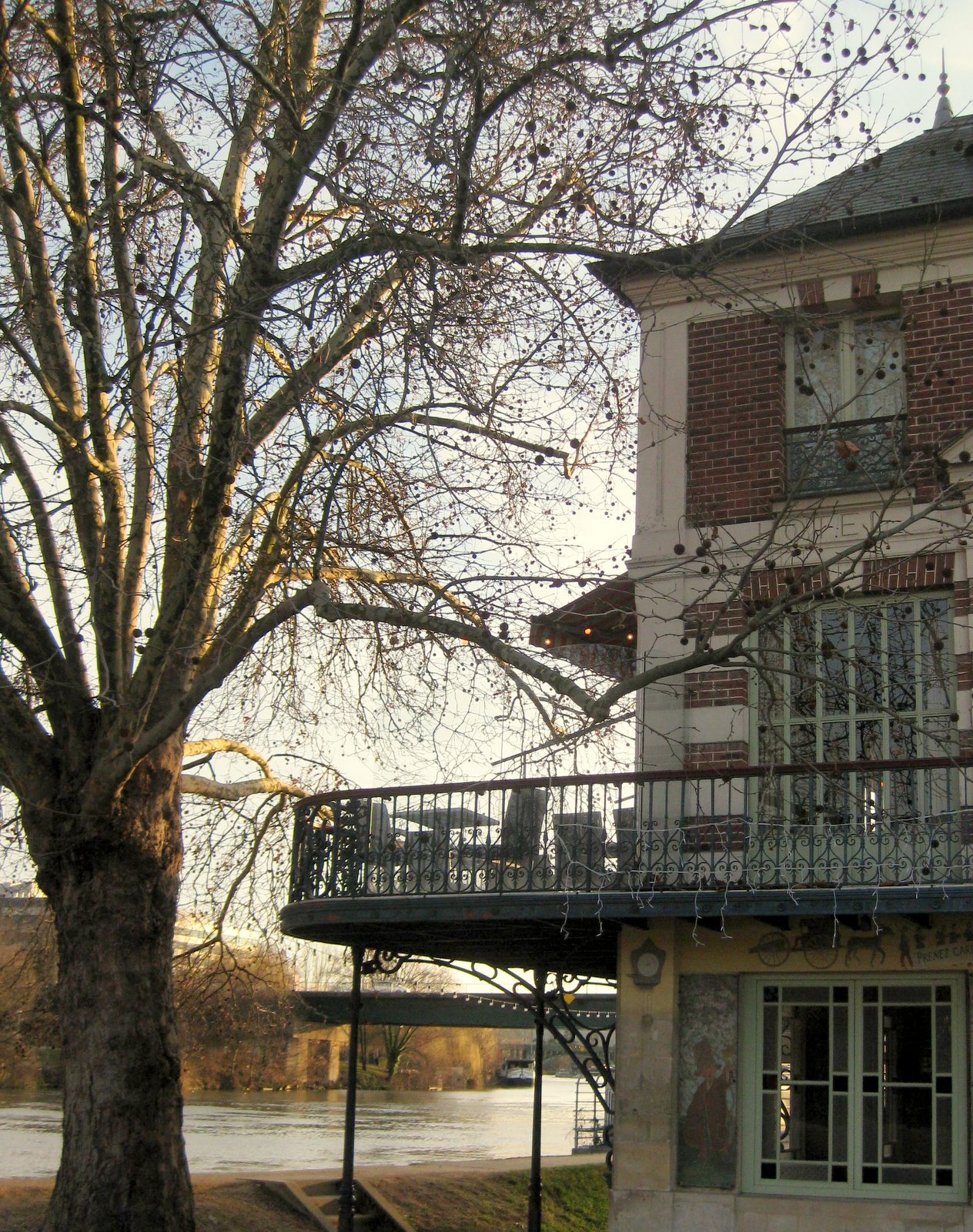
We crossed over to the Ile des Impressionnistes at Chatou and set out to find the la Maison Fournaise, the last surviving guinguette. The landscape across the river toward Paris has changed dramatically, but the Maison Fournaise looks much the same as it did more than a hundred years ago. Its exterior was aglow in the light of the setting sun, but inside all was dark. Our hopes of a warm drink on the balcony made famous by Renoir were dashed. Instead, we walked across the bridge and into an inviting, but decidedly less famous cafe, where we ordered espresso and pain au chocolate


There we sat - subjects for a modern-day artist - two good friends at a table by the window in a Paris cafe, talking and laughing and whiling away the end of a beautiful day.

To see more photos, click here.

Recommended Reading:
Yvette
by Guy de Maupassant
(Chapter 2 has a lively description of la Grenouillière.)
Click here to read in English on Ebooks.


A bientôt,
Geraldine


Photos by Geraldine Calisti Kaylor


Thursday, April 29, 2010

PARMA


As the train pulled into the Parma station, my train of thought went like this: Parma - Parmigiano-Reggiano cheese -  Prosciutto di Parma - pasta with prosciutto and Parmesan cheese - sandwiches with prosciutto and ripe, red, middle-of-summer New Jersey tomatoes - Grandma's risotto made with alternating ladles of homemade red sauce and chicken broth, stirred constantly and finished with sauteed chicken livers and lots of fresh-grated Parmesan cheese. Food and Parma just seem to go together.

As soon as we arrived on a recent visit, it was clear that Parma is a food town. Tempting-looking restaurants are everywhere, serving Parma's signature pasta dish Tortelli d'Erbetta. Incredible markets line the elegant streets, all of them packed to the rafters with prosciutto,  parmesan and culatello. And where else can you find Musei  del Cibo - The Food Museums, three of them, devoted to tomatoes, prosciutto and cured meats, and parmesan cheese? 


It turns out, however, that there's a lot more to Parma than just ham and cheese. 

Its 12th-century cathedral is decorated with frescoes by Correggio, a 16th-century master of light, color and perspective. You have to strain your neck a bit to see the assumption of the Madonna into heaven that adorns the dome, but it is well worth the effort. This is no solemn-faced Madonna with clasped hands, but rather a joyful one with bare feet and raised arms, whose bright, white garments are blowing in the soft heavenly wind.  

Next door is the majestic Romanesque baptistry, built entirely of rose-colored Veronese marble. Octagonal in shape, it is one of the most remarkable baptistries in Italy. Its interior has a high, fan-shaped ceiling and is covered with frescoes, and sculptures by Benedetto Antelami, the 12th-century master who designed the baptistry. (Take along a small pair of binoculars. They are indispensable for seeing details on works of art far above your head.)

From the 1500s to the 1800s, Parma was ruled first by the Farnese dynasty and then by the French Bourbons. They gave Parma a lasting culture of literature, art, theater and music. Verdi operas were performed in its Ducal Theatre; conductor Arturo Toscanini  was born in Parma and the town is home to the Farnese Theatre and the Regio Theatre. Music festivals are held throughout the year and there are two interesting music museums. The National Gallery, housed in the enormous Palazzo della Pilotta, has works by Parmigianino, Canova, Teipolo and Leonardo da Vinci.

Many Italian cities, including Pisa, have a faded, albeit charming elegance. (Recently, with Italy in dire financial straits, faded is the predominant word as the lack of care for all but the major monuments is becoming more and more evident.) Parma, on the other hand, shows no sign of this fading glory and could very easily be the film set for a 18th-century period drama. The obligatory duel could take place in the long, straight walkways of the Ducal Gardens. A carriage ride out to the palaces in the nearby hills (today accessible by bike paths) would be a perfect place for a love scene. 

And even though it's not all about the food, I'm sure our film would include a romantic tete-a-tete across a candlelit table in an elegant Parma dining room. Our couple would gaze lovingly into each other's eyes. And then, perhaps, they would be happily distracted - just as we were - by the arrival of the first course of a wonderful dinner: succulent Tortelli, filled with soft ricotta cheese and wild field greens, bathed in sweet butter and generously adorned with Parmesan cheese.  

(Click here for the recipe. For photos from la Repubblica, click here. Even if you don't understand Italian, the photos are very instructive.)

Click here for more photos of Parma.


Buon appetito,
Geraldine


Photos by Geraldine Calisti Kaylor