 |
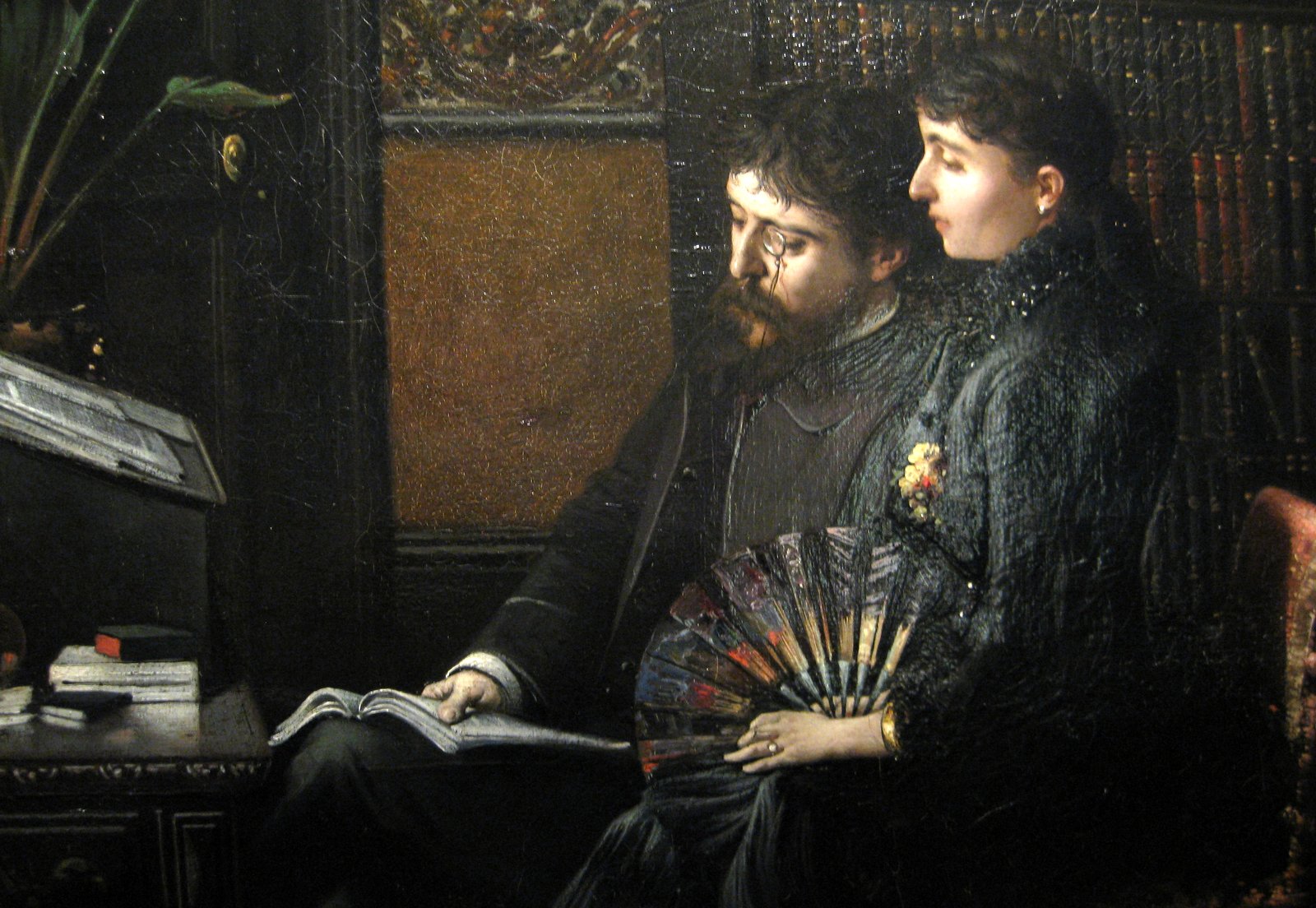
| "Alphonse Daudet in his studio with his wife, Julia Allard" Louis Montegut, Carnavelet Museum, Paris
Travel Oyster is back. As I hope you've noticed, the blog has been on vacation for the last few months. I decided to take a little respite from my self-imposed deadlines, incessant photo-taking, painstaking recipe testing and time-consuming research on historical facts. I've spent much of the past long, hot summer in our little, rustic cabin in the North Woods of Michigan. It's cooler there; people are scarce; and nature is plentiful. It's a good place to relax, think and, of course, read. Which, in turn, leads me to this year's edition of Travel Oyster's Great Books.
For Great Books IV, I've chosen a classic Italian cookbook on regional dishes; a well-known and well-loved book of 19th-century tales of France's sunny Provence region; an engrossing, fascinating, page-turning history of the 14th Century, and a book of beautiful 360º photographs of Tuscany;
 by Ada Boni Translated by Matilde La Rosa When this cookbook first appeared in Italy in 1928, Italian women, like their counterparts in the rest of the world were enjoying new freedoms. In her preface to the first volume, Boni congratulated them for their achievements, saying: "Many, among you know how to play the piano very well or can sing with exquisite grace; many others have grand ambitions for higher learning; you know modern languages, are pleasingly literate or fine painters or you can take the wheel of a luxury car with a steady hand." But, she goes on to say, "how many of you, if you make just a little examination of your conscience, can say that you know how to boil two eggs to perfection." The Talismano della Felicità (Talisman of Happiness), as it is known in Italy, is universally recognized as the country's standard national cookbook. My version, the first Italian cookbook I ever owned, was originally published in 1950. It's a no-nonsence, easy to follow, unillustrated book, adapted for American cooks. Oddly enough, it doesn't tell me how to boil an egg, but its stained and annotated pages attest to its constant use. Its almost 1,000 recipes include regional dishes from all over Italy, but my copy seems to open of its own accord to those of southern Italy, such as Whole Eggplant Sicilian Style or Fresh Sardines Palermo Style. (I make this in the spring with fresh Michigan smelts replacing Palermo's wonderful sardines.) Even though it is adapted for American cooks, this is an Italian cookbook, not an Italian-American one. Some cookbooks lose their appeal for me after time, but this one never has. It remains, along with Marcella Hazen's Essentials of Classic Italian Cooking, one of my two favorite books of Italian recipes.  by Alphonse Daudet First published 1869 Written when Alphonse Daudet was still in his 20s, this book is, nonetheless, a nostalgic look back at the region of Daudet's birth. The mill in question is a windmill that Daudet bought on the heights of the town of Fontvieille, near Arles, in 1864 when he was just 22 years old. Combining folk tales with descriptions of everyday life and ordinary people, Daudet weaves a web of interlacing stories that create a Provence at once dreamlike and very real. The book is among the most accessible and well-loved masterpieces in French literature, and reveals the humor and finesse of one of France's great storytellers. The French is not difficult, but there are also several good translations in English. To read an English translation of the book free online, click here.  by Barbara W. Tuchman I bought this book years ago, but didn't get around to picking it up until last month. Since then, I haven't been able to put it down. A Distant Mirror chronicles life in Europe in the 14th Century. First published in 1978, the book was on the New York Times Bestseller List for more than nine months, and I can see why. It's wonderfully written and meticulously researched. Its cast of real people includes kings, cardinals, beggars, thieves, saints and serfs as well as perhaps the Western World's first feminist writer. And, of course, there are the knights in all the glory of chivalry and all the brutality of war, terrorism and torture. Marked by three great plagues that killed nearly half the population, the 14th century was a time when loyalty often gave way to treachery and where political assassinations were commonplace. Corruption in the Court and in the Church, opulence among the rich, and unbearable taxes on the poor and middle class led to a universal longing for reform. Yet amid all this chaos, great cathedrals and castles were built, beautiful illuminated Books of Hours were produced and poetry and art flowered. Although a world away from us, the book is indeed a distant mirror of our own times - a reflection of the same human strengths and foibles that mark our own century. A Distant Mirror, in fact, begins with a quote from John Dryden: "For mankind is ever the same and nothing is lost out of nature, though everything is altered."  Photographs by Ghigo Roli My last pick is an easy on the brain, delight to the eye coffee table book. Part of a series that also includes books on New York, Venice and Paris, this book has dream-inducing, 360-degree views of Tuscany. Many of the places photographed in the book, including Pisa, Populonia, Elba, Massa Marrittima, San Galgano and Siena, have been featured in past postings of Travel Oyster. So, if you're looking for a getaway on a long winter's evening, buy the book and surround yourself with beauty. Then click on the links above and take a Travel Oyster visit to Tuscany. Until next time from Paris, 
Geraldine
|
Showing posts with label Books. Show all posts
Showing posts with label Books. Show all posts
Thursday, December 6, 2012
GREAT BOOKS IV


Wednesday, January 19, 2011
THE PATH OF THE IMPRESSIONISTS

In the summer of 1880, the Impressionist painter Pierre-Auguste Renoir was in Chatou, hard at work on a future masterpiece. He invited a friend in Paris to come for a visit. "You won't regret the trip, I assure you" Renoir wrote. "There is not a lovelier place in all the surroundings of Paris."
 |
| Courtesy Phillips Collection |
The painting that Renoir was working on was "The Luncheon of the Boating Party" (Le Dejeuner des Canotiers). In it, many of Renoir's friends, including his future wife, Aline Charigot, sit in the sparkling sunlight on the balcony of la Maison Fournaise, a guingette in Chatou.
On a recent morning in Paris when the sun made a rare winter appearance, I decided to heed Renoir's advice and visit Chatou, which is on the banks of the Seine just seven miles west of Paris.
 |
| Courtesy Musée d'Orsay |
Instead of the train, my friend Marcelle and I headed out of Paris on the more convenient RER, the regional branch of the Metro. Three stops beyond Chatou at St. Germain-en-Laye, we began the four-mile walk that would take us not only back toward Paris, but also back through time.
The chateau of St. Germain-en-Laye, dates to 1124 and was the birthplace of King Louis XIV. We crossed the park of the chateau and headed down to the river, where the scenery in many places is still surprisingly bucolic. Glimpsed through the trees or across the shimmering water, the towns of Le Pecq, Bougival, Croissy and Chatou look very much as they did in the time of the Impressionists.
Barges still pass as they snake their way from Paris to the sea, but the cafes, bathhouses and all but one of the famous guinguette - those raucous dance halls painted and patronized by numerous Impressionists - have disappeared.
 We walked up the river toward Croissy-sur-Seine and on to the Bougival bridge, the subject of an 1870 Monet painting. Halfway across, we descended steps to the Ile de la Chaussée. The island was also known as the Ile de la Grenouillière, in honor of a popular guinguette on the island that, in its heyday, attracted a cross-section of French society. People swam and boated during the day, and ate, drank, danced and loved away the night. A popular guide book of the time gave this succinct description: "La Grenouillière, just between us, is not exactly a recommended spot for clergymen."
From this island, it's a short walk across a connecting dike to Ile des Impressionnistes. When we arrived at the dike, however, a locked gate barred our way. In formal administrative language, a large sign announced essentially that because of high water, the dike was unstable and we risked drowning in the Seine. Marcelle, being French, was all for defying this attack on our liberty, and urged that we go forward. What came to my mind, however, was the Great Flood of 1910 and the drowning, not far from this very spot, of Alphonse Fournaise, the son of the family that owned la Maison Fournaise and one of the young, happy people in "The Luncheon of the Boating Party." No matter how romantic, I did not want my first view of the Ile des Impressionnistes to be my last. Although still certain of her position, Marcelle agreed to turn back.

She was right, of course. From the other side of the river, we could see people (presumably French) walking the full length of the dike, high above the water. On the other hand, our detour took us past beautiful villas built in the late 1800s, small, balconied riverfront houses in Chatou and the town's beautiful Church of Saint Leonard and Saint Martin, built in the second-half of the 13th century.

She was right, of course. From the other side of the river, we could see people (presumably French) walking the full length of the dike, high above the water. On the other hand, our detour took us past beautiful villas built in the late 1800s, small, balconied riverfront houses in Chatou and the town's beautiful Church of Saint Leonard and Saint Martin, built in the second-half of the 13th century.
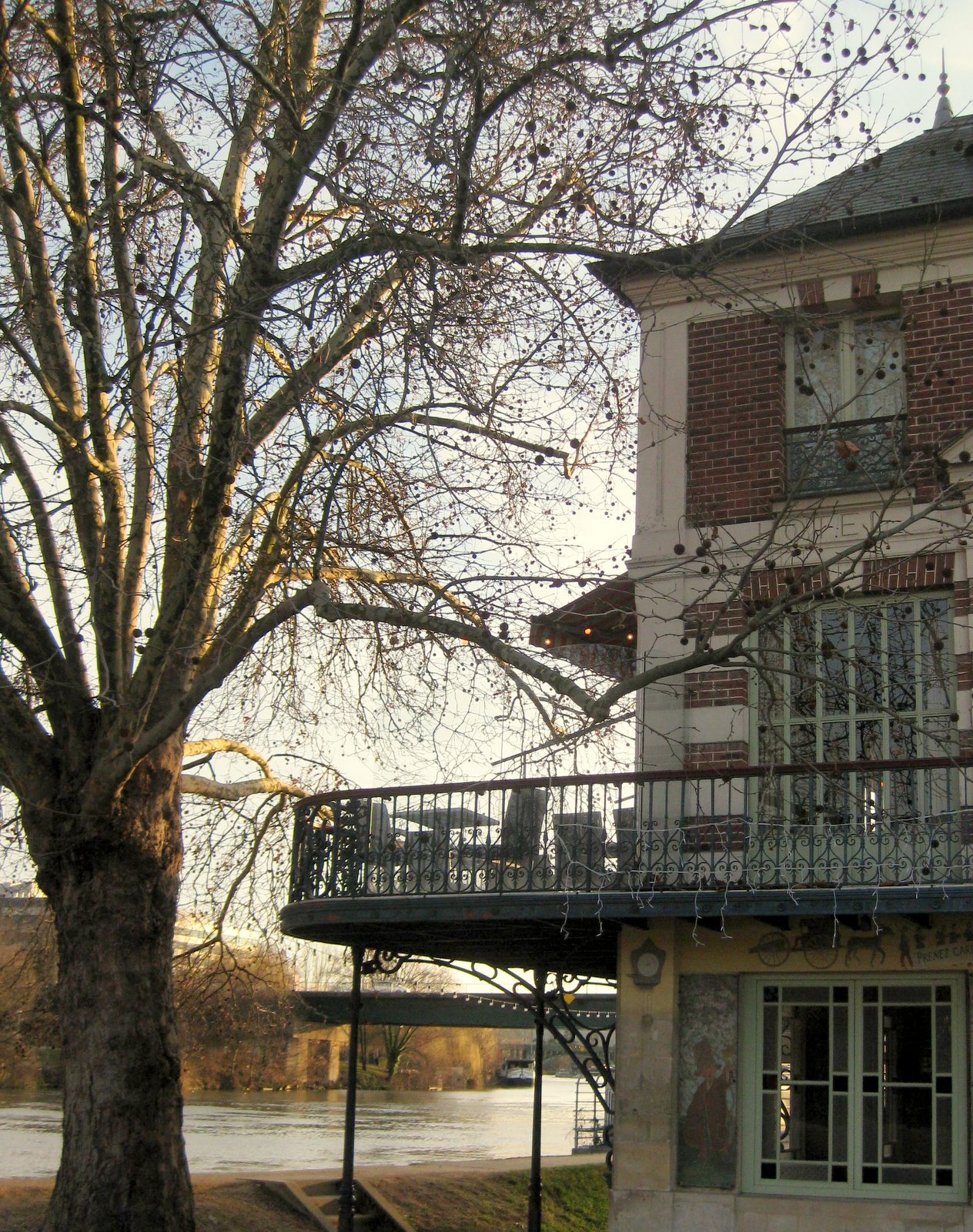
We crossed over to the Ile des Impressionnistes at Chatou and set out to find the la Maison Fournaise, the last surviving guinguette. The landscape across the river toward Paris has changed dramatically, but the Maison Fournaise looks much the same as it did more than a hundred years ago. Its exterior was aglow in the light of the setting sun, but inside all was dark. Our hopes of a warm drink on the balcony made famous by Renoir were dashed. Instead, we walked across the bridge and into an inviting, but decidedly less famous cafe, where we ordered espresso and pain au chocolate.
There we sat - subjects for a modern-day artist - two good friends at a table by the window in a Paris cafe, talking and laughing and whiling away the end of a beautiful day.
(Chapter 2 has a lively description of la Grenouillière.)
Click here to read in English on Ebooks.

A bientôt,
Geraldine
Photos by Geraldine Calisti Kaylor
 Paris
Paris France
Tuesday, June 23, 2009
Idlewild, Michigan - Paradise Revisited

Our cabin in northern Michigan sits in the middle of a big oak forest. On a summer night the only sounds are the burbling of the cold, fast-moving trout stream that flows in front of the house, the rustling of unseen night animals and the persistent clear and haunting call of the whip-poor-will.
For two nights in July, however, if the wind is right, the night woods fill with the hot and sultry sounds of blues and jazz from the nearby town of Idlewild. It's a small echo of America's segregated past, a time when the town was one of the most popular African American summer resorts in the country.
 Idlewild was a sanctuary from the racist Jim Crow practices and laws that African Americans faced in their everyday lives. On a summer day, as many as 25,000 people jammed into Idlewild on roads such as Justice Avenue, Celestial Boulevard, Righteous Road and Wisdom Way. Music could be heard all night long, every night, in the Paradise Club, the Flamingo Club, the Purple Palace and the El Morocco, an after-hours club that closed at 8 a.m.
Founded in 1912, Idlewild gave African Americans the opportunity to buy land in a beautiful setting. Small lots, 25 x 100 feet, were sold for 35 dollars with six dollars down and payments of a dollar a week. The community also acted as a touchstone of black identity and culture. Early land owners included W.E.B DuBois, Charles Chesnutt, and Daniel Hale Williams, who performed the world's first successful open heart surgery in 1893.
The example of these progressive-minded citizens coupled with an alluring advertising campaign convinced many black professionals to buy large pieces of land in Idlewild. In their book, Black Eden authors Lewis Walker and Ben C. Wilson state: "To be able to relax and have a holiday and also be a part of discussions and developments on race was an exciting and exhilarating experience for many."

Today Idlewild is a shadow of its former self. Its famous clubs and most of its motels, shops and restaurants are gone. When segregation legally ended in 1964, African Americans began to frequent places previously denied to them. Idlewild businesses found it difficult to compete in this changed environment and the slow decline of the town began.

The natural beauty remains and the lakes are still lined with neat vacation cottages, many owned by people with memories of forty, fifty and even sixty Idlewild summers. The town is much smaller and poorer than it was in its heyday, but there are signs of revival. One of them is the annual Idlewild Music Fest, a celebration of Idlewild's musical heritage.
This year's festival, the sixth annual, will be held on July 9 and 10 on Williams Island on Lake Idlewild. As a publicity flyer says: "Back in the day, everybody who was anybody made an appearance by the lake and people in the know had front row seats." We've already bought our tickets.

Geraldine
To see an historical poster for Idlewild, click here.
To read about Idlewild's fascinating history, I recommend the following book:

Black Eden, The Idlewild Community
by Lewis Walker and Ben C. Wilson
Michigan State University Press, East Lansing, 2002.
Photos by Geraldine Calisti Kaylor
 Michigan
Subscribe to:
Posts (Atom)
