Showing posts with label Michigan. Show all posts

Wednesday, June 25, 2014

Michigan Blue Heaven


                                          Morels and wild asparagus with the Pere Marquette River in the background


An American friend of mine in Paris, who is definitely a big-city kind of girl, shakes her head in disbelief when I describe our cabin on a river in northern Michigan. She knows that we spend two months in Paris and two months in Pisa each year and can't imagine going from the myriad offerings of those two cities to what she calls "wilderness." "What do you do there?" She practically wails when she says this.  

It's true that life at the cabin is definitely a far cry from the bright lights and big city feel of Paris or the medieval splendor of Pisa.  In fact, it's a pretty far cry from anything. The closest grocery store in Baldwin, population 800, is about six miles away on roads that are largely unpaved. There are no fancy restaurants, cafes, cinemas or art museums.  The town does have two canoe liveries,  a hardware store, a good little library with internet, an ice cream and fudge shop and, most surprising of all, twice-weekly jazz and blues concerts all summer long. There are lakes and streams for fishing and canoeing and hundreds of miles of forest bike and hiking trails. Lake Michigan, where you can find beautiful, secluded white sand beaches, is just 40 miles to the west.   


Our cabin is modest. At 720 square feet, it's just a bit smaller than the 80-square meter apartment we rent for two months each year in the Marais neighborhood of Paris. The screened-in porch adds another 200 square feet - and a view that many Parisians might envy. It's here that JR and I have our "offices," facing a bend of the Middle Branch of the Pere Marquette River, a national scenic trout stream. There are a few other cabins not far from us, but they are lost from view around the serpentine bends of the river. The opposite bank is federal land, where the only neighbors are forest animals, birds and butterflies. White oak, sugar maple, aspen and cedar trees fill the forest and tower over the cabin. 

Guests get to stay in the Love Shack - a separate building that was in complete disrepair when we bought the property 15 years ago. JR and I rebuilt it and restored it to its former rustic glory, and my sister Michele, one of its first occupants, named it. It's just big enough for a bed, a dresser and a chair, but its four big windows bring the outside in. A bistro table and chairs, a gift from my French friend Marcelle, bring a touch of Paris to the Love Shack's screened-in porch. The small espresso machine is a reminder of Italy.

The river up near our cabin is small, but deep and cold. Trout hide in the under banks and in season, steelhead and salmon spawn in its gravel bottom. The calm bends of the river are filled with mounds of watercress, whose slender green shoots spill out into the river, gracefully undulating in the fast-moving current. In springtime wild asparagus line the riverbanks. In summer,  bright orange Michigan lilies and startlingly red Cardinal flowers take their place. Spring through fall, mushrooms - morels, chanterelles and porcini  - flourish in places that will remain my secret.

Although not as obvious to the casual observer, life in the "wilderness" is just as busy and chaotic as life in the big city. It hums with activity day and night and its bucolic appearance belies the great dangers that lurk for the creatures who live there. When we arrive in springtime, though, love is in the air. An attentive observer can find the architecturally perfect nest of the hummingbird; hear the high-pitched cheeps of the Towhee nestlings; witness two wood turtles making love; or come upon a fawn bedded down in the tall grass.   

The city sounds of Paris are a world away, but like the big city, the woods are almost never silent. The wind whispers or sometimes roars through the trees; the river babbles; the chipmunks chip; the deer snort; the birds sing; and, this year unfortunately, the mosquitoes buzz.   

Melting snowpack from one of Michigan's coldest winters in decades coupled with heavy spring rains created a perfect storm for the breeding of mosquitoes and ticks. And then, there are the turkeys. A couple of weeks ago, while hunting mushrooms in the early evening, I was charged by a mother turkey when I inadvertently came too close to her nest.  I ducked behind a tree and the turkey and I - Walt Disney cartoon fashion, circled it - I right next to the trunk and she about 10 feet away.  My yelling got her to retreat, but as I made for home, she followed me for about a half-mile gobbling and squawking the whole way.  

I'm not sure how much damage a turkey can do, but I can tell you that being charged by a 30 pound turkey at breakneck speed is unsettling.  For a while it made me wonder why I was not sitting instead at a sidewalk cafe in Paris. 

 
But then as I made my way back to the cabin in the gathering darkness, a whippoorwill began to sing. The words of a classic Fats Domino song came to mind. 

When whippoorwills call and evening is nigh,
I hurry to my Blue Heaven.
A turn to the right, a little white light,
Will lead me to my Blue Heaven. 
To see more photos, click here.

Happy Summer, 
Geraldine

Tuesday, November 5, 2013

Caviar from the Great Lakes


Click on any photo to enlarge and see all photos


Waking up at 4 a.m. to go fishing on a cold Michigan morning, driving an hour, and then sitting in a small boat on a windy lake may not be everyone's idea of a good time. Mist often rises over the lake, and even with your headlamp, you can barely see the end of your fishing rod.  Other boats slip in and out of view, their lights twinkling in the pitch dark of the pre-dawn hours. 

Then the sun begins to rise, turning the sky a dazzling red. You cast and recast your line and wait for a slam at the end of your rod. It's fall and prime time for Lake Michigan chinook salmon. If all goes well, in the two or three hours after dawn, you'll land one or two fresh, silver salmon from Lake Michigan. And if you are very lucky, at least one of them will be a female, full of shiny pearl-like, coral-colored eggs. Eggs, which  by the end of the day, you will transform into sumptuous caviar.

Strictly speaking, salmon caviar is not real caviar. That designation goes only to caviar made from the roe of wild sturgeon from the Caspian and Black Seas. Beluga, the most famous of the caviars - the favorite of  James Bond, the hero of Ian Fleming's novels - sells for $200-$300 per ounce. These days, however, you would have to be a spy - or a crook - to get your hands on real beluga caviar. The sale and import of beluga has been banned since 2005 by the Convention on International Trade in Endangered Species. 

Originating 200 million years ago, sturgeon have outlasted the dinosaurs, but are now one of the planet's most threatened species according to the International Union for the Conservation of Nature. Native to subtropical, temperate and sub-Arctic waters in Europe, Asia and North America, sturgeon can live up to 100 years, reach lengths of seven to 12 feet, and weigh up to 1,000 pounds. Prior to European settlement of the North American continent, a species of lake sturgeon was abundant in the Great Lakes.  By the late 1800s, the commercial catch of lake sturgeon in the lakes averaged more than 4 million pounds per year. In 1929, the catch had declined to only 2,000 pounds and Lake Michigan was closed to the commercial harvest of sturgeon. Habitat loss, pollution, destruction of spawning areas due to deforestation and dam construction also contributed to the demise of the lake sturgeon fishery. 

A remnant population of lake sturgeon stills exists in the Great Lakes today and according to the Michigan Department of Natural Resources, lake sturgeon throughout the Great Lakes appear to be on a rebound. Commercial fishing remains prohibited and sport fishing is highly regulated, so it may be a long time before any true caviar is available from the Great Lakes. 


On the other hand, Lake Michigan is teeming with salmon and a few years ago, I started wondering if fresh-water salmon eggs could be used for caviar. Turns out they can. So one day, I dropped by the dock where the fishing boats come in and asked a guy who was about to toss a beautiful fresh egg sack into the grinder if I could have it. "Gonna use it for bait?" he asked.  "No, I'm going to make caviar," I said. "Better you than me," he replied. Indeed!

Since then, JR and I have been catching our own salmon, early in the season when they are just entering the river from Lake Michigan. Most of our fishing in the Pere Marquette River in front of our cabin is catch and release, but we always take two or three salmon from the lake. This year we kept two large females, which in addition to producing beautiful fillets for grilling and smoking, also gave us 64 ounces of delicious, shimmering caviar.

Making caviar is a fairly simply process. The skein holding the eggs is slit open and the eggs are removed, which is the most difficult part since each egg is firmly attached to the egg sac. With practice, this part of the process can be accomplished in about an hour.  After that, the eggs are washed and put in a brine solution.  Here is the recipe:

Salmon Caviar

1 cup salmon eggs
2 cups of cold water
1/2 cup Kosher salt


In a glass bowl, mix the salt into the cold water and stir until it is dissolved. Put in the eggs and leave for about 30 minutes, stirring occasionally with a nonmetalic spoon. Drain the caviar and put it in small glass jars. Store the caviar in the refrigerator where, in my experience, it will remain fresh for two or three months -  if it lasts that long.


According to tradition, beluga caviar should be served with a mother of pearl spoon and eaten by itself without garnish. We like our salmon caviar on toast served over a spread that we make with hummus (without tahini) and mashed avocado.

If you are lucky enough, like us, to live near salmon waters and have lots of caviar, then I recommend my favorite recipe, caviar pasta. 


Pasta with caviar sauce

Linguini or spaghetti
olive oil or butter
chopped chives
juice and peel of a lemon
caviar

While the pasta cooks, put the olive oil or butter and the chives into a pan and sauté briefly.  Add the lemon juice and lemon peel.  When the pasta is cooked al dente, drain it and put it back in the pasta pan with the sauce on a low flame just until it is good and hot. (If it's too dry, simply add more olive oil or butter.) Remove from the heat and gently fold in 2-3 ounces (or more) of caviar.  Serve topped with another dollop of caviar and chopped parsley.

Sturgeon farming is now being practiced in many countries that have or had a native sturgeon population, including France, Italy and the United States. Markey's, the only company in the United States authorized to raise beluga sturgeon, also raises several other varieties of sturgeon on a farm in southern Florida.  Their stock now numbers 100,000 live fish.  Their beluga caviar is not yet for sale, but a beluga-type caviar, known as Osetra, is available online at Markey's for about $300 an ounce.

Salmon caviar from Alaska may be available at a Whole Foods store near you for about $16.99 an ounce. Or if you are in the neighborhood, come on by - we still have a jar or two of Michigan salmon caviar in the fridge.  But hurry, because it's going fast.


        Geraldine 
(with a caviar producer)


Photo by JR

Wednesday, September 28, 2011

The da Vinci Coda - A Michigan Horse Tale


In 1499, the victorious army of Louis XII of France entered Milan, Italy by the Vercellina Gate and camped in the neighborhood of San Vittore al Corpo. On entering the city, the soldiers came upon an enormous clay sculpture of a horse. Commissioned by the Duke of Milan, Ludovico Sforza, in honor of his father and as a symbol of the power of the Milan, the finished statue in bronze was to be placed before the Sforza Castle.

Flush with victory and perhaps anticipating more battles to come, the French soldiers used the statue for archery practice. In the ensuing years, the elements reduced the already partially-destroyed clay sculpture to rubble. Thus, one of the great works of the Italian Renaissance genius Leonardo da Vinci disappeared forever. 

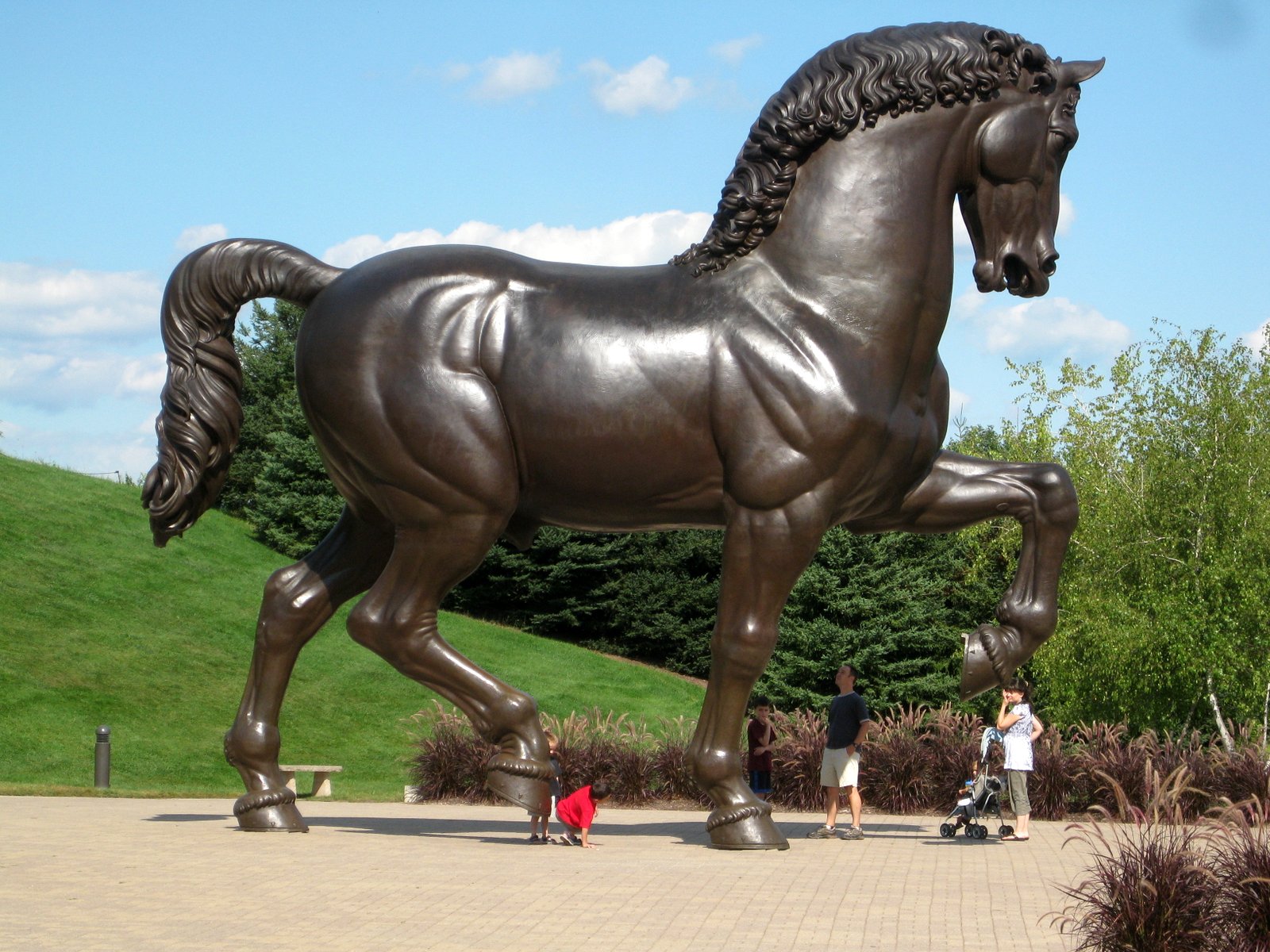
Thousands of miles and hundreds of years removed from Milan, Italy, is Grand Rapids, Michigan, home to the Frederik Meijer Gardens & Sculpture Park. Recently, after taking a visiting relative to the Grand Rapids airport, we passed the gardens on our way back to our cabin in northern Michigan and decided to pay them a visit. As expected, we found well-tended flower gardens, fountains, winding paths and beautiful sculptures, by artists such as Rodin, Picasso, Miro and Moore. What we did not expect to find was the reincarnation of Leonardo da Vinci's monumental horse.

Leonardo worked on il cavallo from 1482 to 1493, first on the artistic and anatomical elements of the horse and then on the more difficult technical problems associated with the bronzing of what would have been the world's largest equestrian statue. Work was stopped, however, when Ludovico decided to use the 100 tons of bronze needed to cover the seven-meter (23 feet) statute to make canons to defend Milan from the invading French. The effort was futile. Milan fell, Ludovico was imprisoned and the sculpture was lost.

In 1977, Charles Dent, an American airline pilot and amateur art lover read an article in National Geographic magazine. Entitled "The Horse That Never Was," the article told the story of Leonardo's legendary destroyed masterpiece. Dent decided, then and there, to recreate the lost sculpture and gift it to the City of Milan. He started a foundation and raised $2.5 million.

Dent produced a model for the replica of Leonardo's horse, but although a great lover of art, Dent was not an artist, It became obvious that a professional sculptor was needed to make improvements to the existing model. Nina Akamu, an talented American artist, particularly known for her animal sculpture, was given the commission. Then in 1994, Charles Dent died.

Dent's horse also seemed moribund when in stepped Frederik Meijer. The owner of a supermarket chain in Michigan and a well-known philanthropist, Meijer had read about the project in an article in the New York Times. He agreed to finance the effort and Akamu set about creating her own model.

Although many of Leonardo's notebooks still exist and are filled with drawings of horses, there is no definitive sketch of the 15th-century Milan horse. Akamu, however, studied the notebooks and other works by Leonardo to come up with her 24-foot-high sculpture, entitled The American Horse, which she feels  is true to Leonardo's designs.  

In 1999, five hundred years after Leonardo's model was destroyed, The American Horse was installed at Meijer Gardens. The same year an identical casting was given to the City of Milan. Il Cavallo, as it is known in Italy, stands at the gates of the San Siro Race Course, far from the City Center.

In 2007, the City of Milan announced that Il Cavallo would be moved from the race track to the park grounds of the Sforza Castle, its original intended site. So far, however, no plans have been made for the move.

The Sforza Castle has been waiting for its monumental sculpture for more than 500 years, but - since things often move slowly in Italy - it looks as if it will have to wait a bit longer.

(There's lots more to see and do at the lovely Meijer Gardens.  To visit their web page, click here.)

Click here to see more photos.


Ciao,
Geraldine


Photos by Geraldine Calisti Kaylor

Monday, October 25, 2010

MICHIGAN AUTUMN


It's a dreamlike autumn in Michigan. The sun shines every day and the air is warm and inviting. The only rain is the soft, steady stream of dappled yellow, orange and scarlet leaves that fall through a clear blue, cloudless sky. 

The vast deciduous forests of the state are famous for their spectacular fall displays of color. This year, however, nature has surprised and awed even long-time Michigan residents like us.  

Pure Michigan, the State's official web site, offers a variety of color tours throughout Michigan. We followed one on the 18-mile long Old Mission Peninsula, which juts out into Grand Traverse Bay. The roads of the hilly peninsula wind in and out and up and down through apple and cherry orchards, vineyards and blazing forests, all set against a backdrop of the turquoise bay. It's just 60 miles from our cabin in northern Michigan, but if we had crossed the ocean to see it, we would have thought it worth the trip.

As I gazed, I wondered, how many leaves are there, on just one maple or oak tree? According to Michigan Forests Forever, a mature, healthy tree has between 200,000 and 250,000 leaves. More than half of Michigan's 56,000 square miles are covered with trees -- 11.4  billion trees --and more than 75 percent of those are hardwoods. Factoring in smaller trees which would have less leaves, but adding in the billions of uncounted shrubs and bushes in the understory, I decided to use a conservative figure of 100,000 leaves for each hardwood in Michigan. By my calculation, that's 855 trillion leaves. That figure makes even the U.S. national debt look small. In fact, if Michigan leaves were dollars, we could pay off the national debt 62 times and still have 10 trillion dollars left over! 

If we had to clean up the leaves, every one of Michigan's approximately 10 million people would have to rake up more than 85 million leaves each. Fortunately, nature takes care of most of them. Still, according to my estimates, we will have to remove about 500,000 leaves from our small lawn in Ann Arbor.   

Dazzling and daunting figures, but as the saying goes, a picture is worth a thousand words. So, click here to see my photos of Michigan in autumn.


Photos can also be seen by clicking here.
For color tour routes in Michigan, click here.
Comments are welcome and can be left below.


Geraldine


Photos by Geraldine Calisti Kaylor


Tuesday, August 24, 2010

BEARS IN THE NIGHT


"Ger, a bear is here."

These are not the whispered words one hopes to awaken to at 3 a.m. on a moonlit summer night - especially when "here" is right there, just five feet away. "She has a cub with her," said JR. Suddenly, the full-length screens that separate our cabin's sleeping porch from the Great Outdoors seemed incredibly flimsy. 

There are bears in our part of northern Michigan, but 90 percent of the estimated 15,000-19,000 bears in Michigan live in the Upper Peninsula. Although we often hear the snort of white-tailed deer in the woods surrounding the cabin, our several bird feeders have never been molested - a sure sign that no bear has passed our way. All that changed as I slowly raised my head and came face to face with Ursus americanus - an American Black Bear. 

Black bears are one of the most extraordinary animals in the forest. When food is scarce during the cold Michigan winters, they go into a state of lethargy from October until April or early May. Asleep in their dens, they reduce their metabolic rate, surviving without eating, drinking, exercising or passing waste. During this time, usually in January, they give birth to one to three cubs, waking occasionally to feed and care for them.

Not eating is a surefire way to trim down and during their long sleep, bears lose up to 30 percent of their fall weight, which can range from 100-250 pounds for a female and 150-400 pounds for a male. When they emerge in the spring, they're very hungry, but have to content themselves with spring grasses and an occasional frog or nest of eggs.  By the time summer arrives, however, bears are eating 11 to 18 pounds of berries, fruits, nuts and insects every day. It takes a lot of foraging to find that much food, so I'm sure well-stocked bird feeders are always a welcome sight.  

Our bears, which we can see quite clearly in the light of the full moon, look like they've been eating well. They're both standing on their hind legs. The mother bear is about 5'3" - just my height, but she weighs about 200 pounds, which is probably what I'd weigh if I ate 18 pounds of food a day. The cub is about three feet tall and is quite a husky little fellow.

Bears have a keen sense of smell, but are very nearsighted. We, however, are obviously well within their range of vision because our bears are looking right at us. If it weren't for the screens and a well-placed sense of caution, we could reach out and touch them. How frightening! How exciting! What a great photo! Nonetheless, I decide this is not the time to get up and grab the camera. 

While we (and the cub) look on, the mother bear makes quick work of our bird feeders, ripping them apart with her sharp claws.  She saves the oriole feeder, the one right next to the porch, for last.  She's so close now that we hear the glug, glug, glug as she downs the syrupy sugar water. Standing there with the bright orange feeder in one paw, she looks like a Disney cartoon character -- so much so that I wait for her to raise her free paw, wipe it across her mouth and say "Ah!" Instead, she drops the empty feeder, whimpers softly to her cub and the two of them lope quickly off into the forest.

A little research the next day reveals that bear attacks in Michigan are extremely rare. Black bears, in fact, are shy and seek to avoid people - unless you provide them with a food source. We've got new bird feeders, but we take them down every evening and lock them away. We also intend to follow the sage advice of Henry H. Collins in his Field Guide to American Wildlife:  
If you see a bear, leave it alone.  Its sense of responsibility to man is quite limited. 

(To learn more about black bears, click here.)
(To see more photos, click here.)


Geraldine

Photos (unless otherwise noted) by Geraldine Calisti Kaylor


Saturday, July 31, 2010

MICHIGAN BLUEBERRIES


At Veggieville in Idlewild, just down the road from our cabin in northern Michigan, and in fruit stands all around the state, the tables are heaped high with deep, dark, juicy blueberries. Not surprising, since Michigan is the number one producer of high-bush blueberries in the United States. First domesticated in the early 1900s, blueberries are native to North America. Although they are produced worldwide, the United States and Canada account for 73 percent (489 million pounds) of the world's blueberry production. (U.S. Highbush Blueberry Council figures.) 

For centuries, blueberries  were a staple of the diets of the indigenous people of North America. Fresh blueberries were baked into cakes topped with maple syrup (another Michigan delicacy) or were dried to enjoy during the long, cold Michigan winters. Wild, tart, intensely-flavored blueberries are still out there in the bogs and forests of Michigan, where members of the Michigan Potawatami tribe once foraged for them. They're free for the picking, but they're much smaller than the cultivated ones so it takes a long time and a strong back to fill your bucket. 

Whether cultivated or wild, blueberries are good and good for you as your mom might say - low fat, sodium free and a good source of fiber and vitamin C. They are great by the handful, topping your cereal or bursting out of muffins - and who could argue with a fresh blueberry pie. As far as I'm concerned, however, there is nothing better on a hot summer day than a cup of homemade blueberry sorbet. 

Here's my recipe. Try it.  It's easy. (If you don't live in blueberry country, the recipe works just as well with strawberries, raspberries, blackberries or other berries that grow in your part of the world.)

BLUEBERRY SORBET

4 cups of blueberries, washed
1/4 cup orange juice
1/4 cup fresh lemon juice 
1/4 teaspoon vanilla extract
1/1/2 cups water
1/2 to 2/3 cup sugar 
(I like tart sorbet so I use the lesser amount)


1. Purée the blueberries in a food processor or blender until smooth or leave a little chunky if you prefer. Stir in the orange juice, lemon juice and vanilla.

2. Put the water and sugar in a saucepan and heat over medium-high heat,stirring to dissolve the sugar. Continue heating until just before it boils.

3. Whisk the syrup into the blueberry mixture and let it cool. Transfer it to an ice-cream maker and follow the manufacturer's directions. I have an inexpensive hand-cranked Donvier model, but you can make sorbet without an ice cream maker. Just put the blueberry mixture in a shallow pan or ice cube trays, put in the freezer and whip the mixture from time to time as it freezes.  

4. Top with a sprig of mint and enjoy.  If you don't eat it all in one sitting, be sure to take the remaining sorbet out of the freezer and put in the refrigerator about an hour before you want to serve it.

To see more photos, click here.


Enjoy,
Geraldine


Photos by Geraldine Calisti Kaylor

Monday, September 28, 2009

Michigan Salmon


It’s autumn. The salmon have arrived and are rising in front of our cabin on the Middle Branch of the Pere Marquette River in northern Michigan. Strong and energetic, they burst out of the water in the clear, morning air. They've come from Lake Michigan, about 100 miles downstream, to spawn in our cold woodland stream full of deep holes and dancing riffles. Three to four feet long, they weigh 20 to 30 pounds and look incongruously out of place. They are, in fact, home - in the very river where they were born.

My memories of my childhood neighborhood were of a wide busy street, big buildings and a long walk to school. When I visited as an adult, however, everything seemed small and close together. I wonder if the salmon feel that way about the river, if they are surprised that their memories are so different from reality.

Like me, the salmon are not native to Michigan. In the 1960s, they were planted in Lake Michigan and several of its feeder streams. They have thrived and every year, we eagerly anticipate their arrival to our part of the river, listening intently for the unmistakably loud splash of a salmon fighting its way upstream.


Now, as I watch from the bank above the river, a female salmon emerges from a deep hole and glides silently onto the redds, the shallow gravel beds where she will lay her eggs. She swishes her tail and rolls on her side, flashing silver. The males follow her much less silently, thrashing and fighting for the right to fertilize her eggs. It is their final battle. After spawning, all the adult salmon die. At the end of the winter, the quarter-inch eggs, which have been safely tucked among the gravel, will hatch. The tiny salmon lucky and resourceful enough to survive a perilous first year in the river, will then make their way downstream and into the big lake. In a few years time, they, in turn, will return to this same river and, perhaps even this same spot, to complete their life cycle.


Fly rod in hand, I walk down to the river. Enticing a salmon to an artificial fly during spawning season is no easy task. It requires skill, patience and a bit of luck. Fishing for salmon certainly teaches patience. Acquiring skill is a lifelong task and luck, as everyone knows, can be elusive.

Luck, however, may be with me today. There is a huge male salmon, just downstream, holding in the fast-moving water along an undercut bank. My first cast, it seems to me, is perfect, but the salmon thinks otherwise and lets my fly drift by - again and again and again.


Instead of casting, I let my fly drift downstream. It sits there just in front of the salmon’s snout. It’s a tiny, tasty-looking egg pattern, but my salmon is not hungry. From the time they leave the lake and enter the river, salmon eat practically nothing. I know that if I annoy a salmon, he may become aggressive and take my fly. My male, however, seems to be a particularly calm sort. For 20 minutes, I do my best to be annoying, drifting my fly downstream and bouncing it off his nose. Finally, it works. My salmon shakes his head, swishes his tail, and silently disappears downstream.
A kingfisher, flashing blue against the autumn reds and golds, flies by protesting loudly. Perhaps his luck has been no better than mine. Deciding to practice patience, I concede today’s battle to the fish. Unlike the kingfisher, I go quietly and without regret, for as Washington Irving said, "there is certainly something in angling that tends to produce a gentleness of spirit and a pure sincerity of mind."


(For a great short video of a kingfisher on a more successful day, click here.)
To see more photos, click here.


Geraldine


Photos by Geraldine Calisti Kaylor