Showing posts with label Museums. Show all posts

Monday, January 27, 2014

Paris Under Paris


…Paris has another Paris under itself; a Paris... which has its streets, its crossings, its squares, its blind alleys, its arteries, and its circulation….Crime, intelligence, social protest, liberty of conscience, thoughts, theft, all that human laws pursue or have pursued, have hidden in this god-forsaken place. 


That's Victor Hugo in Les Miserables describing the dark world beneath the City of Light, which is one of the most extensive undergrounds in the world. Ten stories deep in some places, it's honeycombed with hundreds of miles of metro, sewer, and catacomb tunnels. Water is everywhere -  in reservoirs, canals and even the Bievre, a once-beautiful river that cut across the Left Bank of Paris to empty into the Seine. There are old mines and abandoned quarry galleries, whose stone built many of the great monuments of Paris, including the Louvre and several successive walls of the city. Crypts of churches, bank vaults, the foundations of the ancient Louvre palace, the wine museum of Paris and the elevator equipment for the Eiffel Tower all share space in the underworld. Connected by streets that mirror those on the surface, it's littered with dead ends, and legends abound of people who descended on a lark never to emerge.

And then there are those who are officially there forever. They reside in the Catacombs, the final resting place for the bones of approximately 6 million Parisians past. The first citizens of the Catacombs took up residence in 1786 when their remains were transferred from the Cemetery of the Innocents in central Paris. In use for nearly 10 centuries, the cemetery had become a health hazard for the city's living residents. For two years, night time convoys of carts, loaded with bones covered with black veils, traversed Paris. They were accompanied by a procession of priests in surplices singing the service for the dead. By 1814, the catacombs had received and stacked the remains from all the cemeteries of Paris - rich and poor, young and old, revolutionary and royalist alike. 

Off limits to the public, the underground is illegally visited nightly by an unknown number of cavistes who explore and map the tunnels, paint its walls, party in its galleries, and scuba dive in its reservoirs. Every year, however, another l.4 billion people enter the Paris underground legally, descending into one of the city's 300 metro stations, and riding on 214 kilometers (133 miles) of metro track that crisscross the underworld.  

Before the advent of the metro in 1900, the caverns were a perfect environment for growing mushrooms, known appropriately as champignons de Paris. Once the metro arrived, mushroom cultivation was moved out of the city.

Several years ago, I read in a guidebook that these famous champignons de Paris were still being grown under the city. The book, which seemed quite reputable, said that the entrance to this "secret spot" was located in the emergency room of the Cochin Hospital in the city's 14th arrondissement, an area riddled with underground caverns. I invited my good friend and long-time accomplice Marcelle to come along. She was somewhat doubtful about the accuracy of my information, but was as always game to explore something different. Since it was my idea, I was the appointed spokesperson, even though Marcelle, being French, would surely have explained things better.

In the Salle de Urgence, it looked as if everyone had more pressing business, so we began to look on our own for this secret entrance. Finally, a nurse came over to ask if she could help us. "We're looking for the elevator to the mushrooms," I said. Assuming, perhaps, that my French was bad, she replied. "Les champignons, les champignons? You have a fungal infection?  You need to see a dermatologist."  "No, no," I said, "not that kind of fungus. Mushrooms, champignons de Paris, they grow in the galleries under the hospital and we're looking for the elevator." "Excuse me?" she said - at which point, Marcelle stepped in to better explain the situation. The nurse listened, joined by a couple of orderlies. Even though Marcelle's French was, of course, impeccable, our nurse looked even more confused. "There are no mushrooms," said one of the orderlies, firmly enough so we knew there was no sense in going on. With one more furtive look around, we left with our mission unaccomplished. 


A search of available literature on the subject has yielded little information and illegal entry into the underground is not our forte. However, just last week I discovered an organization of volunteers that conducts an official two-hour, by appointment only tour - 100 steps down beneath Cochin Hospital! Marcelle has written to the organizers to arrange our visit.

Does the secret mushroom world exist? I'll keep you posted. Or as the French would say, a suivre.

If you want to visit the Paris underground, but don't want to risk an encounter with an officer of the law, here are some official visits:


To read about other adventures that Marcelle and I have had, see the following Travel Oyster posts:


A bientôt,
Geraldine


Wednesday, September 28, 2011

The da Vinci Coda - A Michigan Horse Tale


In 1499, the victorious army of Louis XII of France entered Milan, Italy by the Vercellina Gate and camped in the neighborhood of San Vittore al Corpo. On entering the city, the soldiers came upon an enormous clay sculpture of a horse. Commissioned by the Duke of Milan, Ludovico Sforza, in honor of his father and as a symbol of the power of the Milan, the finished statue in bronze was to be placed before the Sforza Castle.

Flush with victory and perhaps anticipating more battles to come, the French soldiers used the statue for archery practice. In the ensuing years, the elements reduced the already partially-destroyed clay sculpture to rubble. Thus, one of the great works of the Italian Renaissance genius Leonardo da Vinci disappeared forever. 

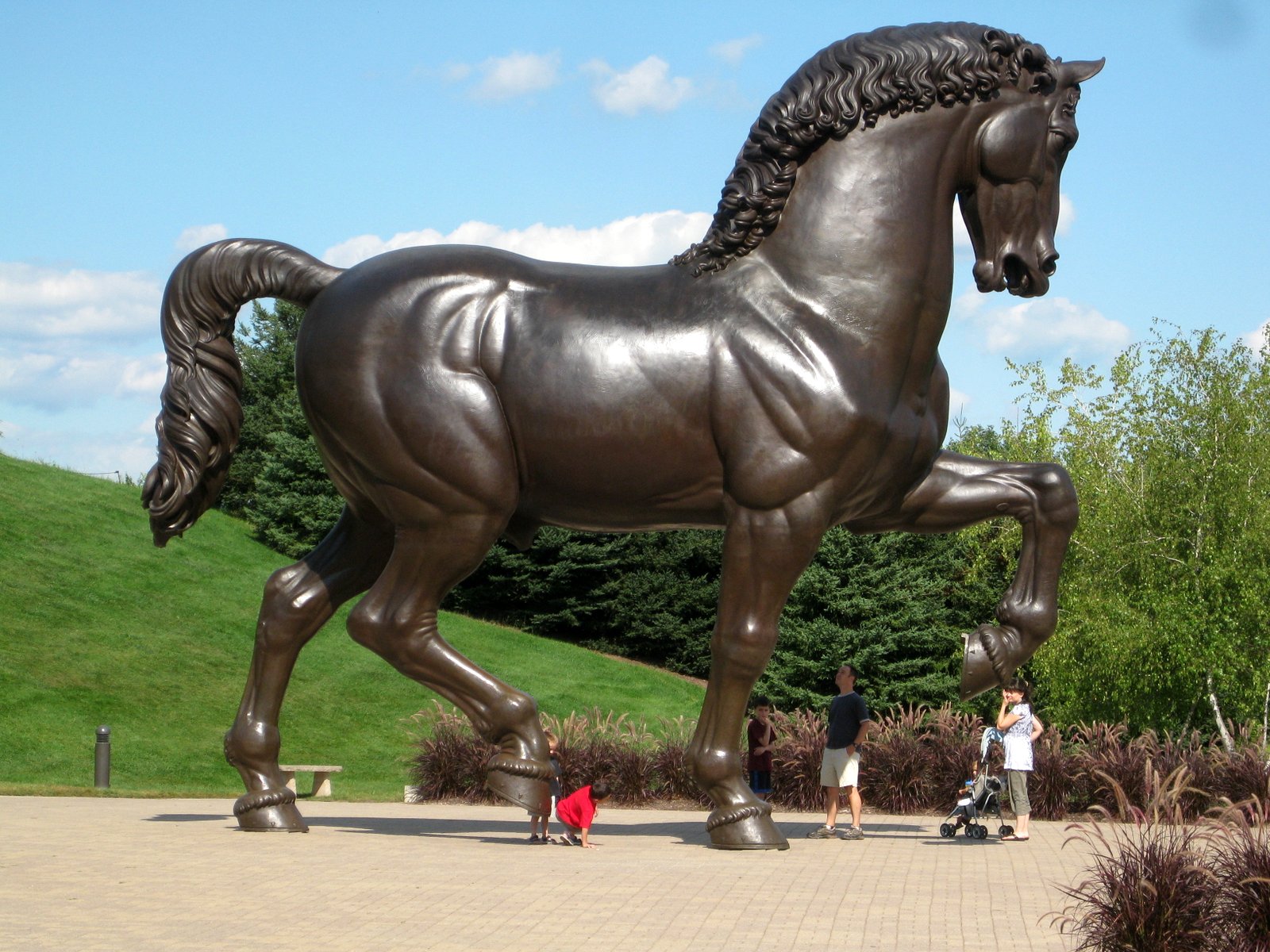
Thousands of miles and hundreds of years removed from Milan, Italy, is Grand Rapids, Michigan, home to the Frederik Meijer Gardens & Sculpture Park. Recently, after taking a visiting relative to the Grand Rapids airport, we passed the gardens on our way back to our cabin in northern Michigan and decided to pay them a visit. As expected, we found well-tended flower gardens, fountains, winding paths and beautiful sculptures, by artists such as Rodin, Picasso, Miro and Moore. What we did not expect to find was the reincarnation of Leonardo da Vinci's monumental horse.

Leonardo worked on il cavallo from 1482 to 1493, first on the artistic and anatomical elements of the horse and then on the more difficult technical problems associated with the bronzing of what would have been the world's largest equestrian statue. Work was stopped, however, when Ludovico decided to use the 100 tons of bronze needed to cover the seven-meter (23 feet) statute to make canons to defend Milan from the invading French. The effort was futile. Milan fell, Ludovico was imprisoned and the sculpture was lost.

In 1977, Charles Dent, an American airline pilot and amateur art lover read an article in National Geographic magazine. Entitled "The Horse That Never Was," the article told the story of Leonardo's legendary destroyed masterpiece. Dent decided, then and there, to recreate the lost sculpture and gift it to the City of Milan. He started a foundation and raised $2.5 million.

Dent produced a model for the replica of Leonardo's horse, but although a great lover of art, Dent was not an artist, It became obvious that a professional sculptor was needed to make improvements to the existing model. Nina Akamu, an talented American artist, particularly known for her animal sculpture, was given the commission. Then in 1994, Charles Dent died.

Dent's horse also seemed moribund when in stepped Frederik Meijer. The owner of a supermarket chain in Michigan and a well-known philanthropist, Meijer had read about the project in an article in the New York Times. He agreed to finance the effort and Akamu set about creating her own model.

Although many of Leonardo's notebooks still exist and are filled with drawings of horses, there is no definitive sketch of the 15th-century Milan horse. Akamu, however, studied the notebooks and other works by Leonardo to come up with her 24-foot-high sculpture, entitled The American Horse, which she feels  is true to Leonardo's designs.  

In 1999, five hundred years after Leonardo's model was destroyed, The American Horse was installed at Meijer Gardens. The same year an identical casting was given to the City of Milan. Il Cavallo, as it is known in Italy, stands at the gates of the San Siro Race Course, far from the City Center.

In 2007, the City of Milan announced that Il Cavallo would be moved from the race track to the park grounds of the Sforza Castle, its original intended site. So far, however, no plans have been made for the move.

The Sforza Castle has been waiting for its monumental sculpture for more than 500 years, but - since things often move slowly in Italy - it looks as if it will have to wait a bit longer.

(There's lots more to see and do at the lovely Meijer Gardens.  To visit their web page, click here.)

Click here to see more photos.


Ciao,
Geraldine


Photos by Geraldine Calisti Kaylor

Tuesday, June 21, 2011

GROUNDS FOR SCULPTURE


Were You Invited?


This past winter, I took a walk along the Seine just outside Paris from St. Germain to Chatou following the path of the Impressionists. (Click here to read.) I ended the day at the Maison Fournaise, the guinguette where Pierre-Auguste Renoir painted his famous Luncheon of the Boating Party. Standing in the winter chill, looking at the deserted terrace, I wondered what it would be like to sit in the warm summer sunshine amid the smiling young faces of Renoir and his friends. I got the answer to my question in a most unexpected place.

Returning home to Michigan after four months in Paris and Pisa, we stopped on the East Coast to visit family. On one of those hot New Jersey spring days that feels like deep summer, we paid a visit to the Grounds For Sculpture, located just outside Trenton. 

Featuring hundreds of contemporary sculptures, most of which are displayed outdoors in its 35-acre garden, the non-profit Grounds For Sculpture opened to the public in 1992 on the site of the old New Jersey State Fairgrounds.    


The New Jersey State Fair became the first sanctioned fair in Colonial America when King George II granted a royal charter in 1745. Held twice a year, it was very popular with local farmers and townspeople who came to buy and sell livestock and other merchandise. Five years later, the State Legislature banned fairs and they did not begin again until the mid-1880s. When I was growing up in Trenton not too far from the fairgrounds, the Fair was still a much-looked-forward-to annual event. By 1980, however, America's fascination with State Fairs began to dwindle, attendance dropped, and the historic New Jersey State Fair closed for good. 

When the Grounds For Sculpture began construction in 1984, the land was hard packed by the millions of visitors to the Fair over the years and seemed an unlikely garden site. Planting began modestly with 12 Japanese maple trees and the garden is added to every year. Today, the Grounds are home to thousands of trees and tens of thousands of shrubs and perennials. It is the brainchild of well-known contemporary sculptor, J. Seward Johnson, known for his lifelike, life-sized bronze sculptures, many of which are to be found not in private collections, but in public squares and parks. Johnson's desire to make contemporary sculpture accessible to people of all backgrounds led to the establishment of the Grounds For Sculpture.

We ran into the first of Johnson's sculptures over a great lunch in the courtyard of the Peacock Cafe. Afterwards, because of the afternoon heat, we wandered over to the shady, flower-lined paths along the lake. It was there that we came upon the luncheon of the boating party. They were all there - Renoir and his future wife, Aline Charigot, and their friends - a complete, life-sized reproduction of Renoir's masterpiece.  Johnson's version includes another table with Johnson and three of his artist friends as well as a maitre d' with a checklist, asking, Were You Invited?, which is the title of Johnson's sculpture. We walked right in and sat down. 

Johnson's art has been called "kitsch," and I can see why. Still, it is hard to resist sitting down in an empty chair, smiling at your new-found friends or in the case of my brother, planting a kiss on Aline's pretty face. It's just what Johnson wants: to convince you of the authenticity of something that isn't real in order to change your perception and allow you to become intimate with a work of art.

There are other Johnson sculptures reproducing the works of the Impressionists scattered throughout the park. You can even find a version of Monet's Giverny garden at Rats, the park's elegant French restaurant.

Johnson's pieces, however, are only a small part of the Grounds For Sculpture, which has more than 250 works by several dozen contemporary artists. They are found around every turn of the elegant and beautifully-tended gardens as well as in indoor exhibition halls.  The halls are renovated 1920s to 1940s State Fair buildings that once housed exhibits of domestic arts, motor vehicles and small livestock. There are also guided tours, lectures, concerts, plays and even opera performances. 

The gardens are a perfect place for a picnic, which you can order up at the Peacock Cafe. There are lots of benches and tables scattered about the grounds or you might just want to picnic with Madame Monet and her son On Poppied Hill, a poppy-strewn hillside based on Claude Monet's Woman with A Parasol (1875) and Poppies (1873).


For a racier picnic spot, seek out Déjeuner Déja Vue, Johnson's version of Edouard Manet's Déjeuner Sur l'Herbe. The subject matter of the original, painted in 1862-63, scandalized the French public and the work was subsequently rejected by the Paris Salon. Today the famous painting hangs in the Musée d'Orsay in Paris.

Déjeuner Déja Vue is cleverly hidden away behind dense shrubs at the end of an unmarked trail. Many visitors never find the art work, but those who do, like us, are likely to experience a sense of surprise and a soupçon of the scandal felt by the French public.

To see more photos, click here.


Until next time,
Geraldine

18 Fairgrounds Road
Hamilton, New Jersey 08619
Phone: (609) 586-0616
Email: info@groundsforsculpture.org 

Photos unless otherwise noted by Geraldine Calisti Kaylor