

In Paris, a walk around the block can take you back centuries. A chance encounter can make history come alive. This is especially true in the Marais, which is filled with magnificent hôtels particuliers built in the 16th and 17th centuries as private in-town mansions for the rich and famous.
Recently, I was photographing the beautiful Louis XV portal of the Hôtel D'Alméras when a man stopped and said: "Ah, Madame, you are so right to photograph those doors. They are a treasure and one that we French almost lost." An elderly man, he was dressed in a finely-tailored topcoat with a cashmere scarf round stylishly around his neck. We'll call him Monsieur D.

It was in 1682, about 70 years after the construction of the Hôtel d'Alméras, that the Marais began to lose its cachet when Louis XIV officially moved the Royal Court about 10 miles southwest of Paris to Versailles. Anyone who was anyone followed the Court, and the elegant Marais began its slow decline. Factories took over the once sumptuous mansions and, one by one, many of the magnificent hôtels were demolished. In the 19th century, when Jews were granted the full rights of French citizenship after the Revolution, the Marais became a center of Jewish life. All that, however, came to a brutal end in 1941-42 when French Jews were deported to concentration camps. After the war, according to Monsieur D., the City of Paris wanted to raze the entire Marais and rebuilt it with modern high-rise structures.

"Aux barricades, les citoyens!" Members of historical groups, architects and ordinary citizens decided to protest and by 1962, the voice of the people prevailed. The Marais was declared the first "protected sector" under a new French law to safeguard a national heritage. Monsieur D. recounted all this as we walked along past several beautiful restored hôtels.
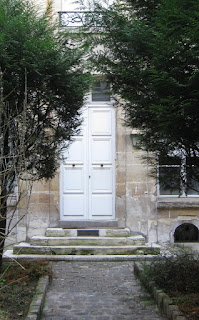
Monsieur D. lives in a hôtel particulier that he purchased and restored more than 35 years ago. "Now the City of Paris lauds the Marais as one of its national treasures," he said, "but when I was trying to buy my building, they made it very difficult for me. They just wanted to tear everything down." When he bought it, his hôtel was in ruins, but being an architect, he saw the potential. "Even my friends said I was out of my mind, but I knew it could be something beautiful. It is right up the street. Would you like to see it?"
Monsieur D. very courteously extended his arm and a moment later, we stood in front of two beautifully-carved wooden doors. He opened one of them to reveal an entryway leading to an interior courtyard. Behind a protected garden where primrose bloomed even in the cold of winter stood his beautiful classic French hôtel. Bird song filled the air and the sounds of the busy street seemed far away.

Standing in the garden, Monsieur D talked about today's Marais, a thriving area filled with fashionable stores, restaurants and bars. Little by little, however, he slipped back into the past - his children, his work, his father. A high-placed French government official during the Second World War, his father opposed the Nazis. As a result, he was imprisoned in France for three years and then handed over to the Germans and sent to a concentration camp. He survived and after the war, he returned to government service.
Monsieur D. now lives alone and like any courtier of times past, he would not think of inviting an unaccompanied woman into his house. Instead, taking my hand he said: "I will keep you no longer. It has been a pleasure, madame. I wish you a good evening.

The next day brought a visit to the Cognacq-Jay Museum. Like many of the Museums of the City of Paris, it has free entry to its permanent collections. If you come to Paris in high tourist season, these city museums can be a welcome respite from the crowds. The Cognacq-Jay is housed in one of the most magnificently-restored hôtels of the Marais - the Hôtel Donon and it seemed fitting to visit it after the encounter with Monsieur D. Built in 1575, the hôtel has been restored to its former glory by the City of Paris. Its purpose, its brochure states, is to "recreate the refinement prevailing in a Parisian mansion in the Age of Enlightenment." Although he is of a later century, it is easy to imagine Monsieur D. quite at home in its elegant and refined surroundings.

À bientôt,
Geraldine
Photos by Geraldine Calisti Kaylor
To view more photos, click here


 Paris
Paris