
Standing next to me in an overcrowded metro recently was a young boy eating his after-school snack. As the train lurched to a stop, he bumped into me and in the process transferred some of the chocolate that covered his face on to my new Parisian coat. With a sheepish grin, the young gamin stuffed the last big morsel of crepe into his already full mouth, then tried to say: "Excusez-moi, Madame." His intent was clear, but the phrase was lost in a mouthful of French delight. It was difficult to be angry in the face of such pleasure and besides, chocolate accidents are to be expected in France in February. It is, after all, crepe month - le mois des crêpes.
The origins of the modern-day festivities are linked to the Christian observance of Candlemas, celebrated on February 2. Tradition has it that in 492 A.D. the Pope offered the Italian version of crepes (crespelle) to the faithful who had come to Rome to celebrate the holiday. The origin of crepes is lost in antiquity, but archaeologists have discovered perfectly-preserved Stone Age pancakes, and third-century Greek writer Athenaeus in The Deipnosophists gives a recipe for crepes very similar to modern versions.
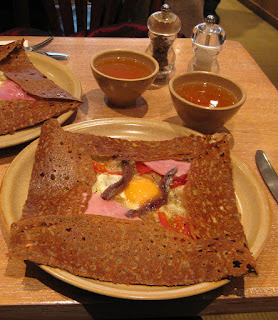 Crepes, in various forms, can be found in almost all countries under many different names. In France, crepes are a speciality of the region of Brittany, where hearty dark buckwheat crepes - also known as galettes - are traditionally filled with ham and cheese, topped by an egg and accompanied by Breton cider. From the Paris region comes one of the country's most well-known desserts: Crêpes Suzette - very thin, light pancakes served flaming in a mixture of liqueurs, usually orange flavored. Crêpes Suzette are so famous, in fact, that their name needs no English translation - a Crêpe Suzette is a Crepe Suzette. (Click here to see British comedian Kenneth Williams sing the very funny Ma Crêpe Suzette - an English song composed entirely of French words.)

Creperies in Paris first appeared in the streets surrounding the Gare Montparnasse - the station where the trains from Brittany arrive. It was there that I tasted my first crepe - not a flaming Crêpe Suzette, but rather a simple, jam-filled crepe, topped with sugar. Anatole France, the French author and poet, who won the Nobel Prize for literature in 1921, could have been describing my first crepes (yes, I had more than one) when he wrote:
"...sprinkled with sugar and eaten hot, they form an exquisite dish. They have a golden hue and are tempting to eat. Thin and transparent like muslin, their edges are trimmed to resemble fine lace."
Crepes make quick, inexpensive snacks that can be purchased from street vendors all over Paris. Their speciality seems to be crepes filled with Nutella, a chocolate hazelnut spread that European kids and adults love - in the same way that Americans love peanut butter. Nutella is probably what the young man in the metro smeared on my coat.
For a more authentic and less messy lunch or dinner, here are three of my favorite creperies. They are all in or near our neighborhood in the Marais, but that will just give you another reason to visit this great part of Paris. At each restaurant, I had a crêpe complête - a buckwheat crepe filled with ham and gruyere cheese, topped with a sunny-side-up egg. In the interest of good journalism, I also sampled (okay ate entirely and then licked my fingers afterward) a simple lemon and sugar crepe, a butter and honey crepe, and a chocolate crepe with pears and vanilla ice cream. Crepes are best accompanied by Breton cider so I had that too - but only one bowl at each place.
 Crêperie Bretonne, near the Place de la Bastille, has great crepes. Walk through the blue doors and you'll feel like you're in Brittany. If you have a good imagination, the sound of passing cars becomes the murmur of ocean waves. The decor is authentic Breton and so are the crepes - rich and flavorful and earthy. Prices are very reasonable and there is a good selection of ciders. The dessert crepes are so good that you'll have a hard time choosing, but chances are you'll love whatever you pick.
 Breizh Cafe sits on a sunny corner in the heart of the Marais. The decor is simple, the staff is friendly and the crepes are authentically Breton. (The original Brezh Cafe is located by the sea in Cancale.) At Breizh Cafe, the crepe itself takes center stage with buckwheat crepes that are dark and strong tasting. The ingredients are very fresh and there is a good variety of ciders that you can buy by the bowl or in larger pitchers. Their dessert crepes, made from a lighter wheat flour, range from the traditional jam and sugar crepes to the delicious chocolate, pear and ice cream crepe, which I shared with a friend (honestly).
 Crêperie Suzette has a lighter buckwheat batter than the other two, but the edges are nice and crispy; the fillings are fresh; and egg is perfectly cooked, meaning a yolk that runs deliciously over the ham and cheese with a white that is firm and moist. There is a lunchtime menu of 11 euros that includes a main dish crepe, a dessert crepe and coffee. It's a small, convivial place and is usually crowded, but there's an upstairs room with a little more elbow room.
For a more authentic and less messy lunch or dinner, here are three of my favorite creperies. They are all in or near our neighborhood in the Marais, but that will just give you another reason to visit this great part of Paris. At each restaurant, I had a crêpe complête - a buckwheat crepe filled with ham and gruyere cheese, topped with a sunny-side-up egg. In the interest of good journalism, I also sampled (okay ate entirely and then licked my fingers afterward) a simple lemon and sugar crepe, a butter and honey crepe, and a chocolate crepe with pears and vanilla ice cream. Crepes are best accompanied by Breton cider so I had that too - but only one bowl at each place.


If you want to try your hand at crepes at home, they are easy to make. For a good basic explanation and recipes, click here. Bon appetit!
For more photos, click here.
(Travel Oyster and I were featured in a Paris newsletter last week. Click here to read about us in Parler Paris Nouvellettre.)

Crêperie Bretonne
67, rue de Charonne (11th)
Tél: 01 43 55 62 29
Briezh Cafe
109, rue Vieille du Temple (3rd)
Tél: 01 42 72 13 77
Crêperie Suzette
4 Rue des Francs Bourgeois (4th)Tél: 01 42 72 46 16
For more photos, click here.
(Travel Oyster and I were featured in a Paris newsletter last week. Click here to read about us in Parler Paris Nouvellettre.)

A bientôt,
Geraldine
Crêperie Bretonne
67, rue de Charonne (11th)
Tél: 01 43 55 62 29
Briezh Cafe
109, rue Vieille du Temple (3rd)
Tél: 01 42 72 13 77
Crêperie Suzette
4 Rue des Francs Bourgeois (4th)Tél: 01 42 72 46 16
Photos by Geraldine Calisti Kaylor
 Paris
Paris France


